Lansing, Michigan
Bats in the Attic in Lansing
Bats in the attic of a Lansing house are confirmed by four kinds of evidence: droppings, staining, sound and the flight out at dusk.
This page defines each one, then explains what a summer colony is and what is done about it.
The four signs
Droppings. Bat droppings are called guano.
A Fish and Wildlife Service assessment guide describes them as small brown or black pellets, "mouse-like in appearance but less regular," with older droppings turning gray.
They build up on whatever lies below the roost and may also stick to beams and walls beneath it.1
Staining. A Forest Service survey protocol tells inspectors to look for body-oil and urine stains on walls and near ceilings.
Which it describes as darkened areas with white edges.2
Sound. The noise to listen for is high-pitched squeaking or chirping.1
The dusk flight. The CDC suggests watching the house at dusk, because the place where bats exit may show how they are getting inside.3
Of the four signs, this is the one that locates the opening.
What a summer colony is
A maternity colony is a group of female bats that gathers to give birth and raise young.
The Fish and Wildlife Service says large groups of bats in the warm months are almost always pregnant and nursing females.
And that they return to the same colonies year after year.4
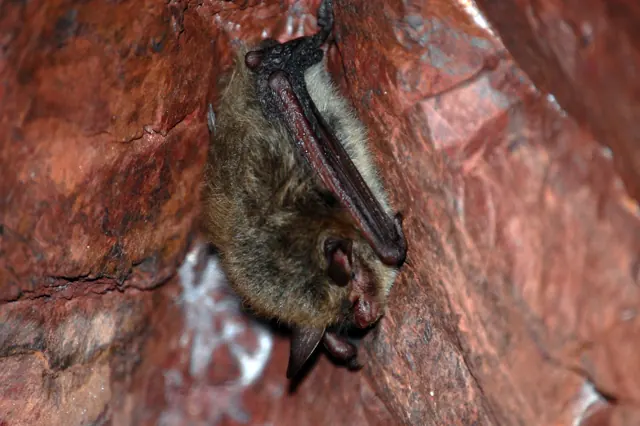
For the little brown bat, the agency says such colonies are commonly in warm sites in buildings, attics among them, and can hold from two to more than 100 animals.5
Each female typically bears one pup, in May or June, and the young can fly in about four weeks.5
Those weeks are why the work is scheduled around the season. The seasonal calendar gives the dates.
Call about bats (517) 815-9996
How bats get in
Bats use gaps that are already there, and the published figures for how small a gap can be do not agree exactly.
The CDC says bats can fit through openings as small as ¼ inch.3
A Forest Service technical report gives holes of 5/8 to 7/8 inch across, and other entryways of at least 5/16 by 1 1/2 inches.
And names cracks, crevices and expansion joints as typical entry points.6
Ingham County's own fact sheet sets a working rule for homeowners: a gap bigger than ¼ by ½ inch gets caulked.7
The practical reading is that no gap at the roofline is too small to check.
Droppings and health
Guano that accumulates in an attic can be colonized by Histoplasma capsulatum, a fungus.6
Breathing in its spores causes histoplasmosis.
The CDC notes that most people who breathe the spores do not get sick, and that adults over 55 and infants are at higher risk.89
Its advice on quantity is plain: large amounts of bat droppings should be cleaned up by professional companies.9
Droppings are not a rabies matter.
Michigan's health department states that contact with an animal's urine or feces is not a rabies exposure.10
A bat loose in a room is a different case, covered on the page about a bat indoors.
Call about bats (517) 815-9996
What is done about a colony
The colony is not killed or trapped. The Forest Service report points out that no pesticide is labeled for use on bats.6
The method is bat exclusion: the bats leave through a one-way device and the openings are closed behind them.
The same report calls it essential that any area where bats roost be well sealed from the spaces people use.6
Calling the line on the home page gets the house referred to an independent wildlife control operator, if one works at your address.
What that operator finds and charges is settled between the two of you.
Two situations, two different jobs
The first situation is one bat in the living space.
It may have come from a roost in the house, or it may simply have flown in.
The U.S. Fish and Wildlife Service notes that bats often enter through an open door on an evening when an outdoor or garage light is drawing the insects they hunt.11
What matters first is whether anyone could have touched it. The page on a bat in the house covers that case.
The second situation is a colony, meaning a group of bats that roosts in the building day after day.
The method used for a colony is called exclusion.
A federal survey protocol for bats in buildings puts the idea in one sentence: "Bats should be allowed to leave the roost, but prevented from re-entering."2
Nothing is trapped and nothing is poisoned. The method itself is on the exclusion page.
Call about bats (517) 815-9996
Lansing's houses, by age
The Census Bureau's 2020-2024 American Community Survey counts 55,943 housing units in the city of Lansing.
The median unit was built in 1959. Just over half, 51.0 percent, went up before 1960, and 24.5 percent date to 1939 or earlier.12
Age alone does not put bats in a house.
The Fish and Wildlife Service's point is narrower: bats do not make holes, they use the ones already there, and they can squeeze through a crevice as small as a quarter.11
An inspection is therefore a search for existing gaps at the roofline, the vents and the chimney, in a house of any age.
Short answers
How do I tell bat droppings from mouse droppings?
A Fish and Wildlife Service assessment guide describes bat droppings as small brown or black pellets, mouse-like but less regular, that turn gray with age.
They collect in a pile beneath the roost. The Forest Service adds that guano crumbles easily because it is mostly insect shell.
How many bats is a colony?
It varies widely.
For the little brown bat, the Fish and Wildlife Service gives a range of two to more than 100 individuals in a maternity colony.
Is it safe to sweep up the droppings myself?
The Forest Service report on bats and buildings says small quantities can be cleaned up with soap and water, with precautions.
And that larger quantities should be left to environmental health professionals.
The CDC likewise says large amounts of bat droppings call for a professional company.
Sources
Sources
- USFWS. Appendix D: Bridge/Structure Assessment Guidance (preliminary bat assessment guidelines for bridges and structures; last revised May 4, 2017).
- USDA Forest Service (Region 6) / BLM bat work group. Bats and Buildings Enclosure 1 (survey protocol and direction for bats in buildings).
- CDC. Preventing Rabies from Bats.
- USFWS. How (and whether) to install bat boxes.
- USFWS. Little Brown Bat (Myotis lucifugus).
- USDA Forest Service (Forest Products Laboratory). Bats, People, and Buildings: Issues and Opportunities (Pfeiffer; General Technical Report FPL-GTR-265, February 2019).
- Ingham County Health Department. Bats in your home (fact sheet, February 2026).
- CDC. About Histoplasmosis.
- CDC. Reducing Risk for Histoplasmosis.
- MDHHS. Rabies.
- USFWS (Midwest Region Office of Communications). Five methods to safely remove a bat from your home.
- U.S. Census Bureau. American Community Survey 2020-2024 5-year estimates, year structure built: Lansing, MI.
- USFWS. Northern long-eared bat (Myotis septentrionalis).
Michigan DNR pages, linked for further reading: Bats.
Bats in the attic, a wall or a room?
Call the bat line (517) 815-9996